|
Roberts Hotel (formally Crown & Anchor Hotel) Two locations: George and Market St.
|
|
|
Left:
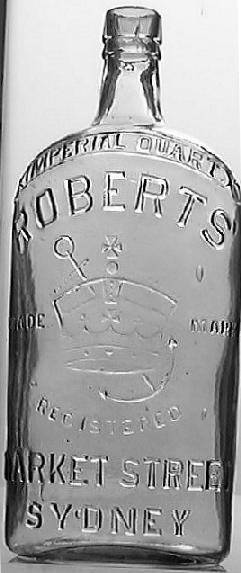
Imperial Quart. Clear glass, applied top. Common. (Available in Imperial Pint - also common). Embossed: "IMPERIAL QUART ROBERTS TRADE MARK REGISTERED MARKET STREET SYDNEY".
Collection/photo - Russell Dunn.
|
|
|
Left:
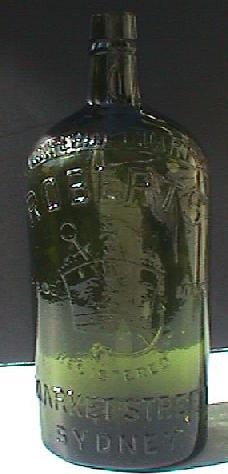
Imperial Quart. Applied top. Common in clear glass but rare in dark green glass. Embossed as above. |
|
|
Left:
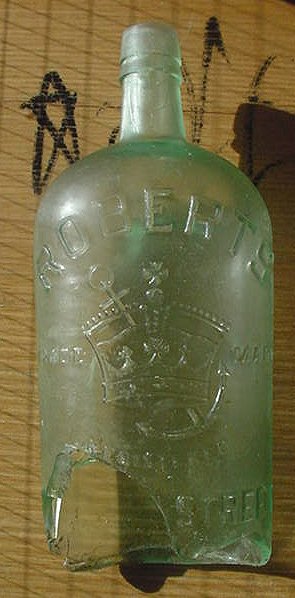
Collecting a specialised item teaches one to look for subtle differences.... If you look carefully you see a (broken) applied top, Imperial Quart - but without "Imperial Quart". Not on the front or the back (N.B. all of the back survived). There is a machine-made Roberts without "Imperial Quart" on the front. But never has an applied top like this been seen before. Perhaps it was one of the last Imperial Quarts in applied tops before the switch to machine-made? Found by P. Fisher in about 6" of water, Central Coast.
|
|
|
Left:
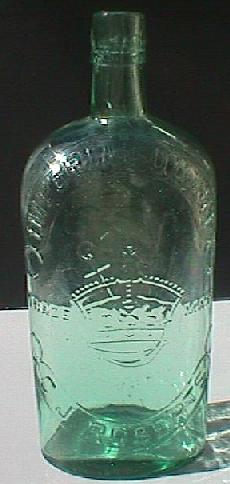
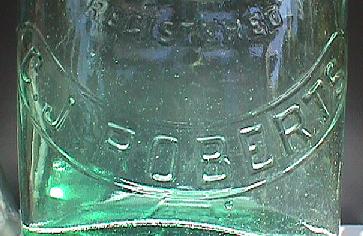
Imperial Quart. Clear glass. Applied top. Extremely rare. Embossed: "IMPERIAL QUART TRADE MARK REGISTERED C.J. ROBERTS". (See close-up below). |
 |
Left:
Close-up of extrememly rare "C.J. ROBERTS" embossing as found above. |
|
|
Left:
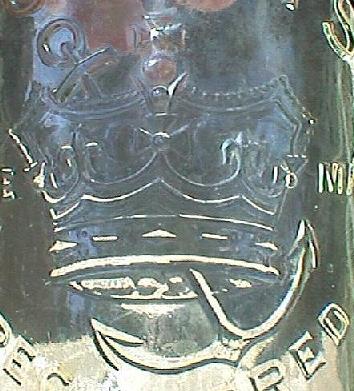
Close-up of crown and anchor logo, with 'scalloped' crown. Found on selected pint and quart bottles. Hard to find. |
|
|
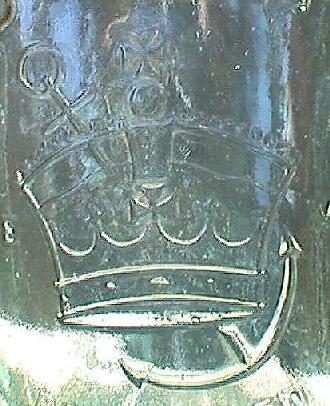
Left: Close-up of crown and anchor logo, with 'straight edged' crown. Found on common pint and quart bottles.
|
| The Roberts Family History/Hotel:
The Roberts family had a history in the Hotel Trade going back to the 1840's at 450 George Street. Henry Roberts was the licencee of the Crown and Anchor Hotel in early forties, and he later sold out to his brother, Charles Warman Roberts, who amongst other things had been a champion rifle shot of NSW. In 1867 Charles' son, Charles James Roberts, took over the proprietorship and soon became one of Sydney's most successful publicans. C.J. Roberts was born in Sydney on March 29, 1864. His early education was at St. James Grammar, Phillip Street, and he later attended Sydney University but was unable to complete studies because of business commitments. In 1877, he became an alderman on City Council, and later became Chief Magistrate of Sydney. In December of 1878 he was elected Mayor of Sydney. During his term of office, Sydney hosted the International Exhibition of 1879-80. His term in office expired in 1879, and he returned to politics five years later when he was elected to the NSW Legislative Assembly for the electorate of Hastings/Manning. When Sir Henry Parkes came to power in 1887 he selected C.J. Roberts to be NSW Postmaster-General. During his time the new ocean mail contract was completed and the Intercolonial Postal Conference was held in Sydney. To show the high esteem to which Roberts was held by his chief, the following words were spoken by Sir Parkes on 13th October, 1887, in the NSW Legislative Assembly: "...with regard to my honourable friend the Postmaster General, I say here that, as far as I am of any value as a judge of official aptitude, I have never seen a more industrious, a more painstaking, amore upright administrator in my life than Mr. Roberts". Thus, in 1888 he was one of few selected to organise centennial celebrations of that same year. The old Crown and Anchor Hotel was demolished in the late 1880's, and a more modern hotel, with five stories, was erected on the same site and renamed Roberts Hotel. This hotel quickly became one of the best, largest and well-conducted residential hotels in Sydney. The large public and two private bars were stocked with wines, spirits, cordials, waters and liquors - containing every brand of spirits, brandy, gin and liquors available at that time. He offered free lunches in all the bars. His own bottles whiskey - the "Robert's blend" - had a high reputation within the trade. In December of 1918, fire unfortunately destroyed the Roberts Hotel. Next door, the Farmer and Co. business secured the now-vacant site in order to expand. The following year, Roberts purchased the old Smart's Hotel on the south-west corner of Market and Pitt Street (known before this as "The Cricketer's Arms") and renamed it The Roberts Hotel. He held a financial interest in this hotel until his death in 1925. His son, Charles Warman Roberts and later his grandson managed the hotel until it was sold in 1949, and thus maintaining the family tradition for five generations.
|
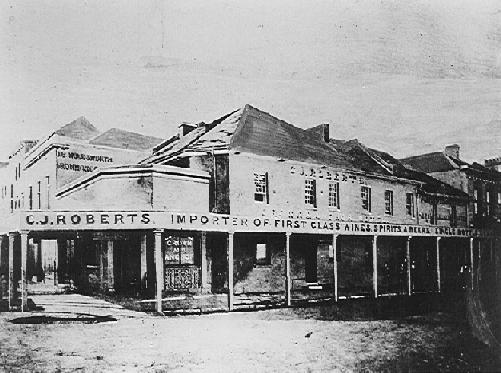
Above: The Roberts Hotel before 1888 (hand touched photograph).
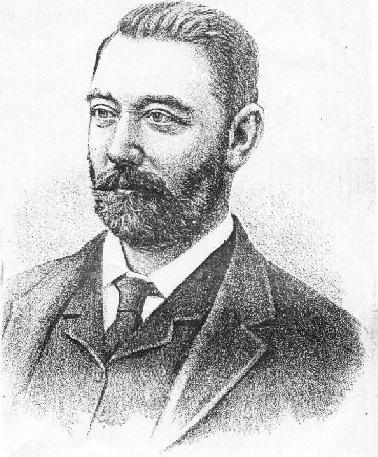
Above: C.J. Roberts - circa 1880's.